Episcopal Church
of the Good Shepherd
SERVICES
SUNDAY AT 10:30 AM
2nd and 4th SUNDAY AT 8:00 AM
WEDNESDAY AT 6:00 PM

Maundy Thursday
The word “maundy” comes from the Latin word “mandatum,” which means commandment. If this is Commandment Thursday, then what is the commandment? Just this:
I give you a new commandment,
that you love one another. Just as I have loved you,
you also should love one another.
(John 13:34)
These are the words that Jesus speaks to his disciples on the evening of the Last Supper, the last hours that he is with his disciples before his arrest and crucifixion. Maundy Thursday is the night when we remember not only Jesus’ commandment, but all the events of that turbulent and emotional night: the gathering in the Upper Room where Jesus celebrates the Passover with his disciples; the washing of the disciples’ feet by their beloved Master; the vigil at the Mount of Olives where Jesus prays while the disciples sleep; and finally, Jesus’ betrayal and arrest.
Our liturgy on this night reflects this broad canvas. We begin with rejoicing: this is the night when Jesus left us his greatest gift, the Holy Eucharist. We wear white to mark this rejoicing. We imitate the actions of Jesus, and we wash one another’s feet, showing that we obey his command to love and serve each other just as he has loved and served us.
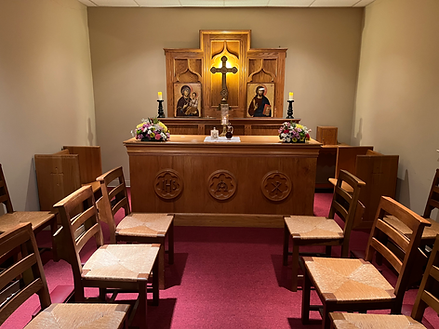
After we have received Holy Eucharist, our liturgy shifts. In a solemn procession, the Holy Eucharist – the Bread and the Wine – are carried to an Altar of Repose. There Christ will remain with us in his Sacramental Presence, even while the church itself is emptied. The chapel that contains the Altar of Repose remains open throughout the night, so that we may sit and rest in the quiet with Jesus, giving our “yes” to our Lord’s question in Matthew 26:40: “Could you not watch with me one hour?”
To help us keep vigil, an off-duty police officer will be present on our campus until 8 a.m. Friday morning, assuring that we are safe whenever we come to sit with our Lord.
After the Sacrament Procession has returned from the chapel, the liturgy shifts again. Remembering that this is the night when the disciples are bereft of Jesus, the night when Jesus begins his long walk toward the Cross, we strip the altar. Stripping the altar – by which we mean removing all ornament and beauty from the altar area – is an act of mourning, an act by which we enter into the desolation and emptiness that the disciples must have felt that night. Piece by piece, we remove all that makes our sanctuary beautiful, from kneelers to altar coverings. Candles are extinguished, gorgeous vestments are removed, cushions are carried away, lights dim. Finally, the priest washes the bare altar and sweeps it clean. The Holy Eucharist will not be celebrated on the altar again until the Easter Vigil, when we will proclaim the Resurrection with our renewed alleluias.
While all this is happening, the choir chants the 22nd Psalm. This psalm begins with the heartfelt cry Jesus utters on the Cross – “my God, my God, why have you forsaken me” – and expresses the anguish of our Lord’s heart throughout his terrible ordeal.
Finally, the service ends in silence. There is no music, and there are no words of dismissal. The clergy and the people kneel in prayer, and exit in the quiet.